
Pro Extended Aisle
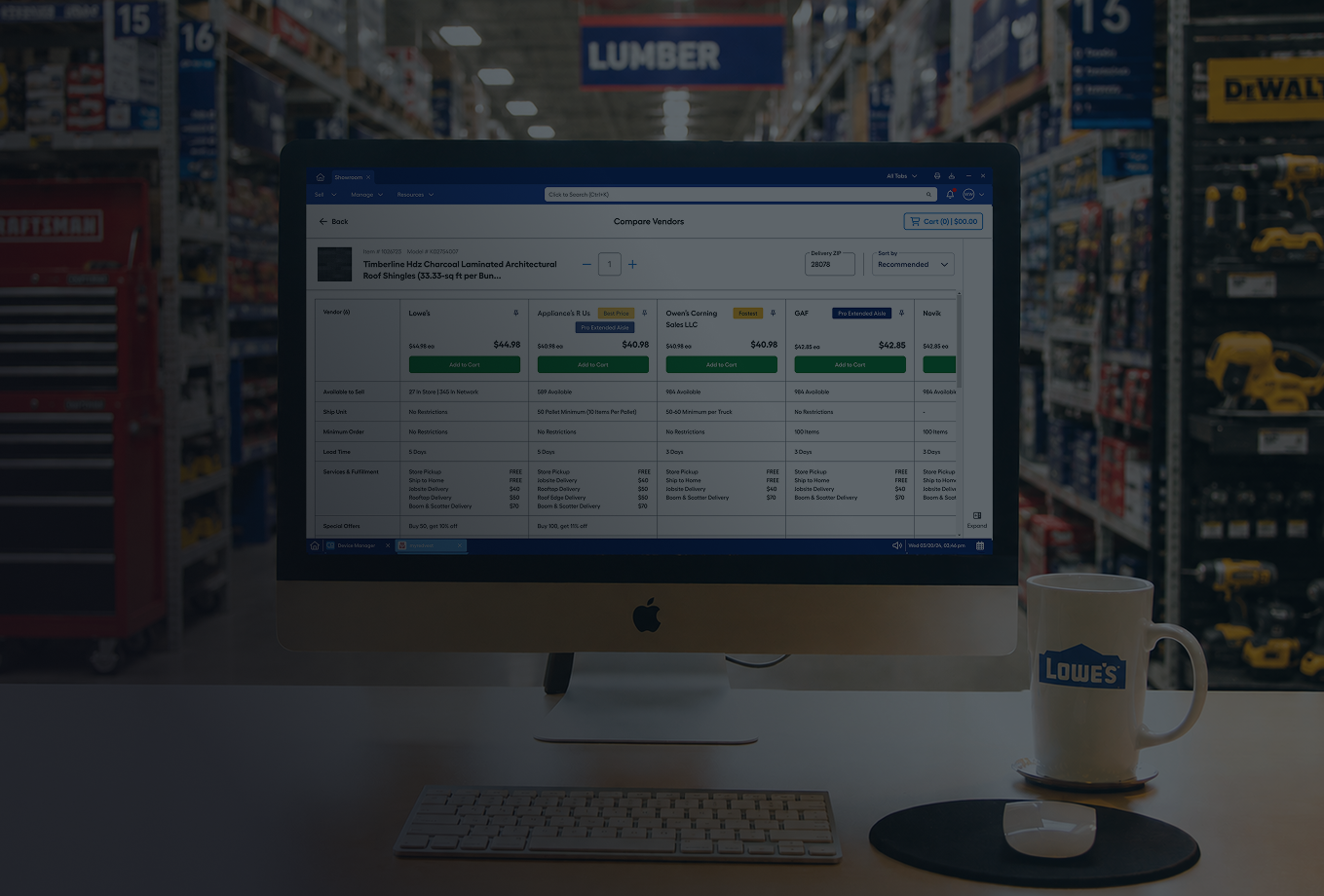
Designing a 400K-SKU catalog experience that lets Lowe’s associates order specialty materials beyond the in-store assortment from any Lowe's location for their professional contractors.
THE PROBLEM
Associates lacked tools to surface reliable alternatives when supplies was unavailable for large contractor orders in-store. Contractors began to lose trust that Lowe's could source what they needed. The result: lost transactions, eroded Pro loyalty, and revenue going to competitors.
THE ASSIGNMENT
Create an associate friendly experience that streamlines the process of viewing Lowe’s expanded digital catalog, real-time inventory and pricing, specialized project delivery options and works alongside AI-driven Material Lists and Blueprint Takeoffs to help contractors generate estimates and place large order in minutes.
THE RELEASE PLAN & RESULTS
Since launch, Pro Extended Aisle has rolled out to all 1,758 Lowe’s stores and cut quote and cart completion time in half. Lowe's leadership has publicly described it as exceeding expectations and a key driver of the company's Pro segment share gains, with new suppliers and markets added weekly as the program scales.
In February 2026, Pro Extended Aisle was featured in Forbes as a cornerstone of Lowe’s Pro strategy and is forecast to beat its 2026 plan by over 60%.
Read the Forbes article here:Can AI Reinvent The Human-Centric Home Improvement Experience?
Read the Lowe’s press release article here:
Lowe’s Strengthens Pro Experience for Small to Medium-Size ProPROJECT RUNDOWN
My Role
Senior UX Designer
Focus area
Employee Desktop Experience
Team
2 UXD · 1 PM · 8 Engineers · 1 Content Strategist
Platform
Desktop, Associate Facing Program
Scope
1,758 stores, 50 US states
Pro Extended Aisle
DESIGN PROCESS
The project began by rethinking how Lowe’s Pro associates build large-scale quotes and orders, and how that experience could support both associate needs and business requirements. Early on, there was misalignment with leadership on direction, so I went into stores to interview and test with Pro associates directly. Those sessions surfaced a clear path forward, which I presented to leadership to gain their buy-in.
Because the experience involved complex math, the process relied heavily on user testing. The goal was to explain each calculation as clearly as possible so associates could build accurate quotes with confidence and without second-guessing the numbers.
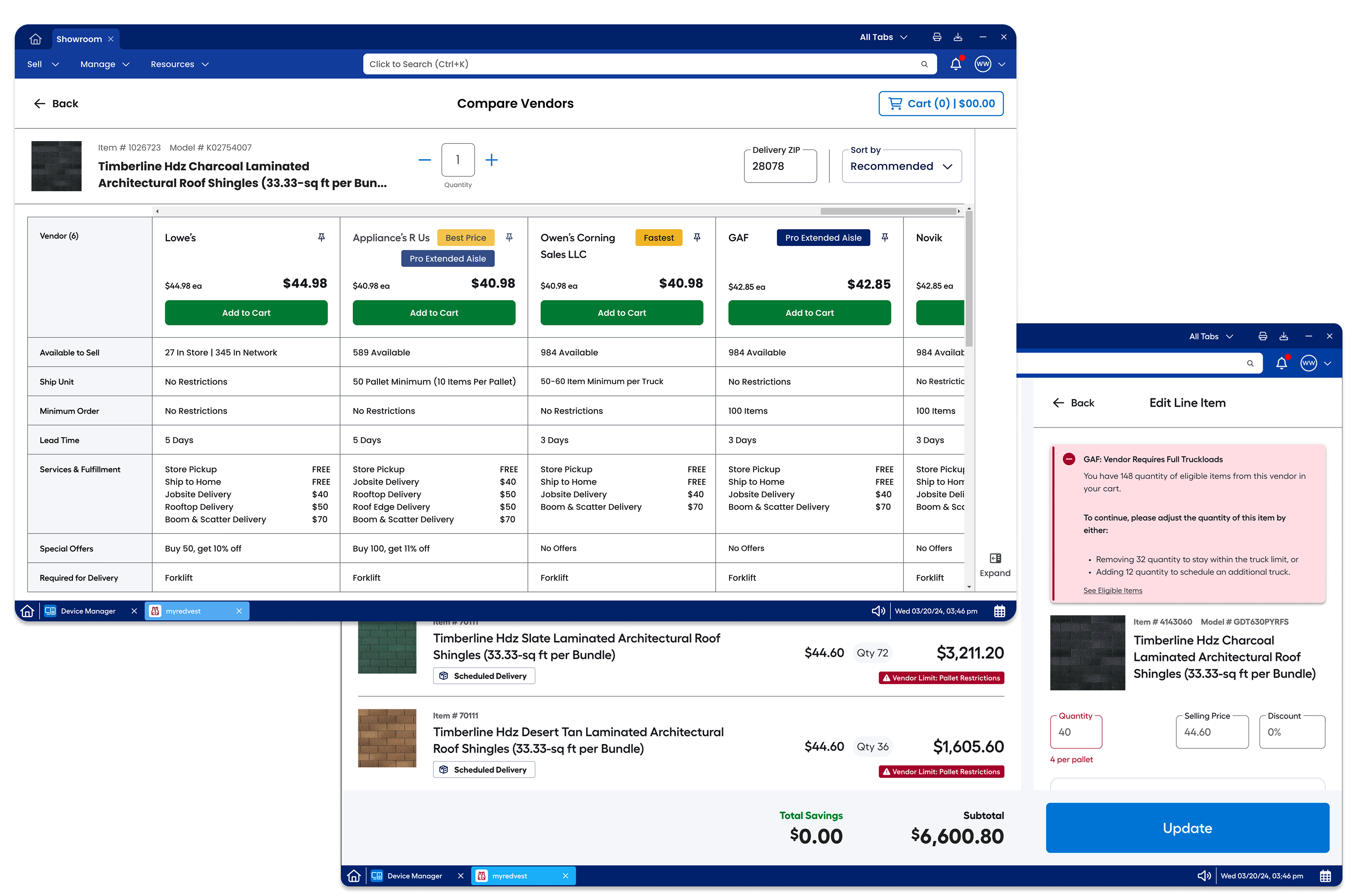
I worked closely with engineering to move as much of the math to the backend as possible, asking associates to handle only what was required by our API restrictions and vendor limitations. We also introduced an eligible items section that shows associates what else they can offer when Lowe’s can’t fulfill a request to the customer’s exact specifications, so a gap in fulfillment still ends in a sale rather than a dead end.
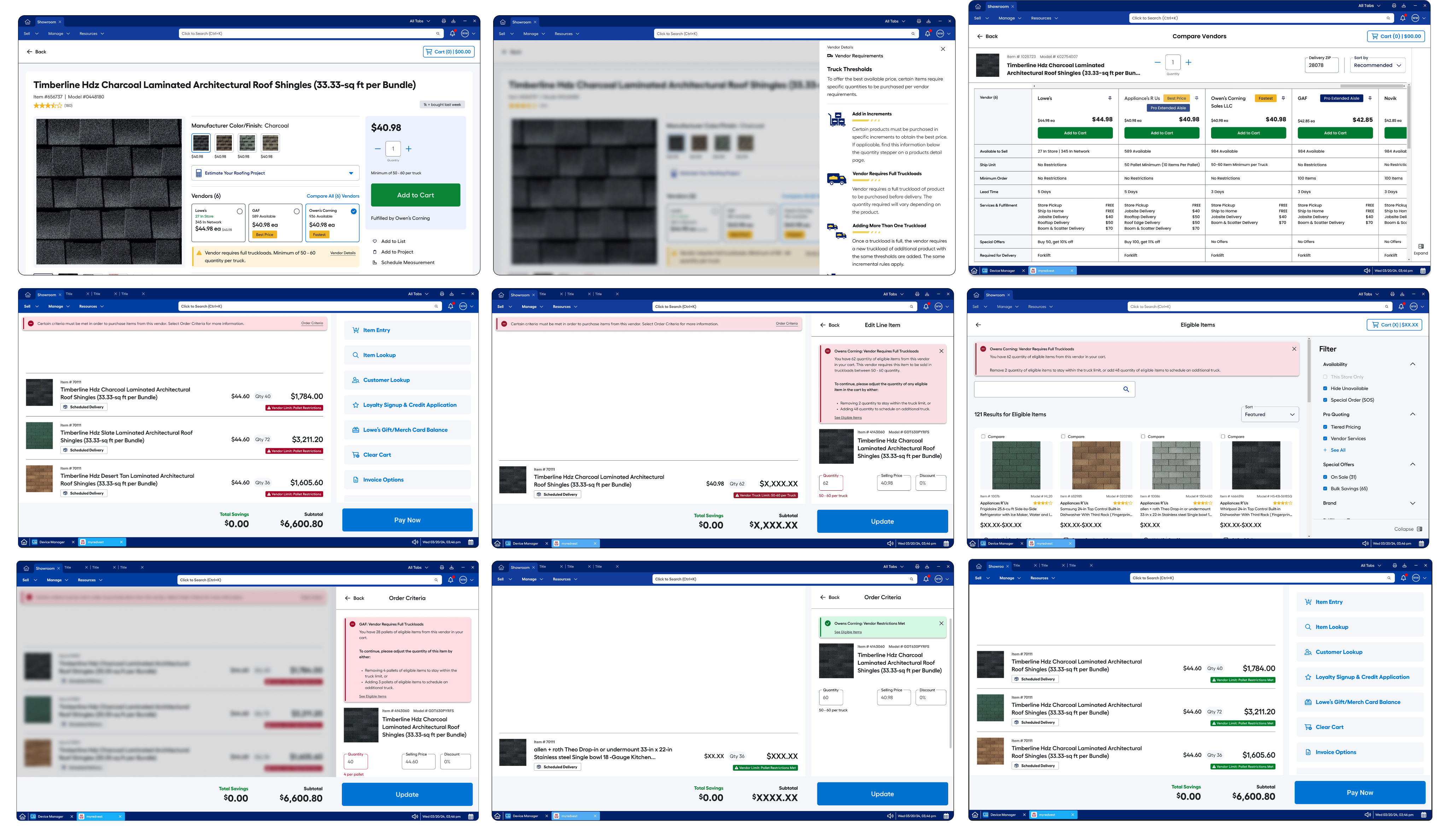
Screens, from left to right.
Top Row: Product Detail Page, Vendor Requirements Fly Out, Pro Extended Aisle Table.Middle Row: Cart with Multiple Errors, Edit Line Item with Single Item, Eligible Items Page.
Bottom Row: Order Criteria Error with Multiple Items, Order Criteria Success with Single Item, Cart Success with Multiple Items.
VALIDATION
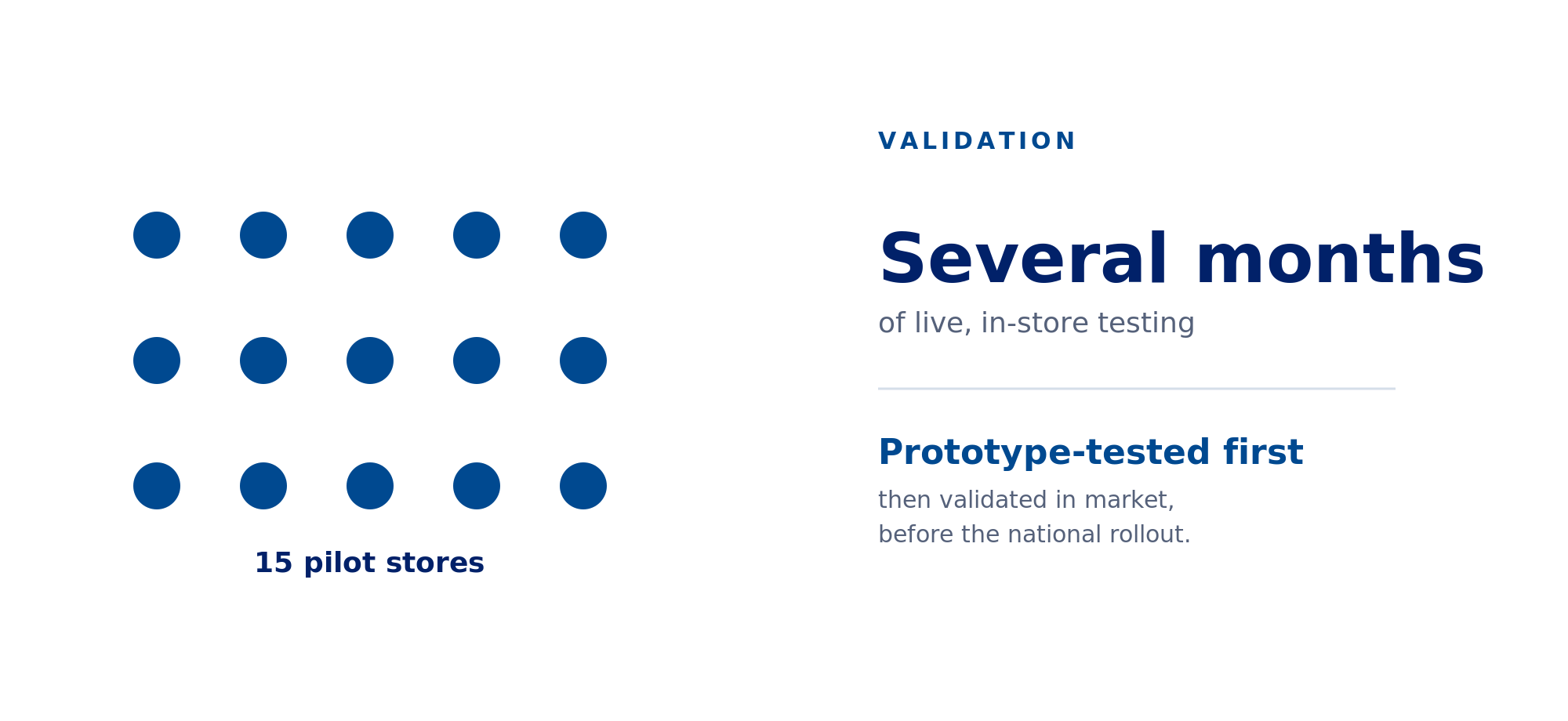
Proven in-store before going wide.Before broad release, we validated the experience with prototype testing and then a pilot in 15 stores over several months, confirming it performed accurately against the real complexity of Pro orders in a live environment before scaling further.
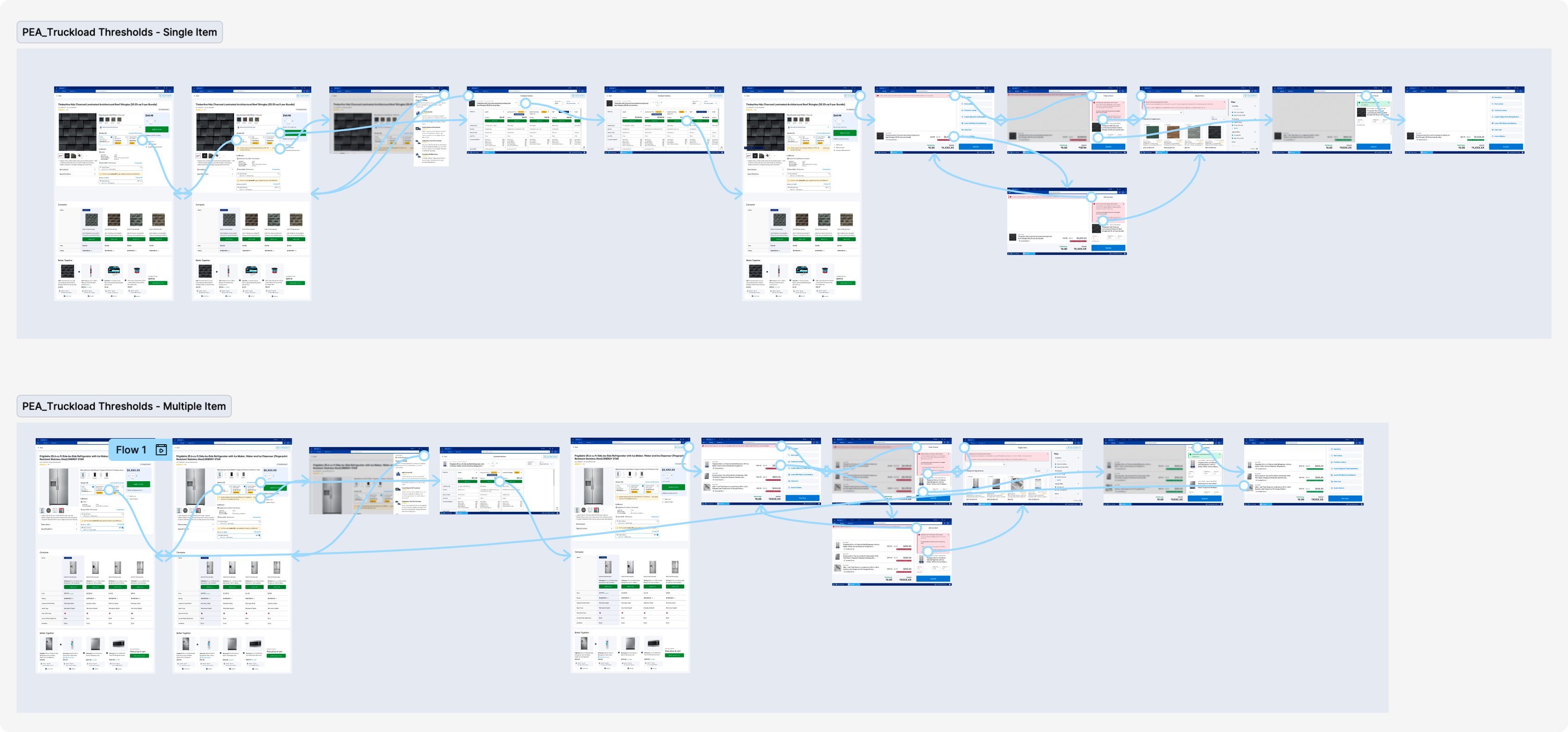
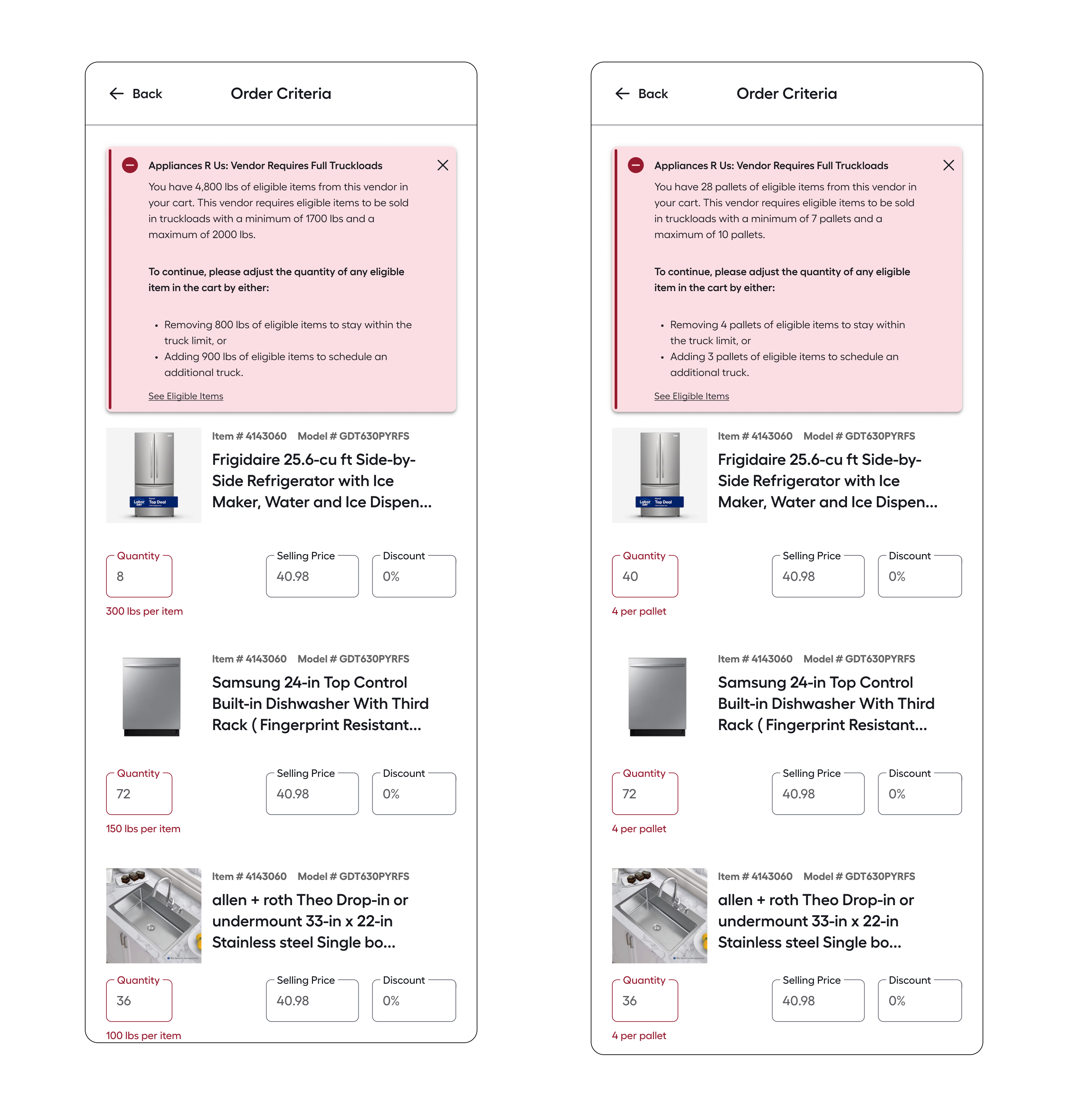
Screenshot of two prototypes used during testing. Top: Truckload threshold testing for single item cart or quote.Bottom: Truckload threshold testing for multiple item cart or quote.
SOLUTIONS & RESULTS
For Pro Extended Aisle, the design focused on introducing a new experience for Pro Desk Associates that streamlined how they access Lowe’s expanded digital catalog, real-time inventory and pricing, and specialized project delivery options. The experience works alongside AI-driven Material Lists and Blueprint Takeoffs to help contractors generate estimates and place large orders in minutes, while minimizing the math associates need to do during quote and cart creation. Testing revealed three core needs: consistent terminology across Lowe’s, contractors, and vendors; as much of the math handled for them as possible; and clear information about all available vendors and products so they could complete sales and meet both Lowe’s targets and their own monthly quotas.
The new experience has delivered measurable improvements across the associate journey. Since launch, quote and cart creation time has been cut in half, and leadership projects the tool will exceed its targets by 60%. The project demonstrated that surfacing hidden product and vendor information, and removing barriers like inconsistent terminology and complex math, can increase sales, retain customers, and keep associates productive.
Video Content
Video shows the user journey through finding an item, viewing vendor details, comparing all vendors available to complete this order, errors within the cart and how to solution these error through guided messaging and alerts.
REFLECTIONS
If I had the opportunity to continue with the project.By the time I handed the project off, we were mid-build on the path toward the ideal state, shipping interim phases while engineering advanced. I left it with a clear vision, leadership alignment, and a phased roadmap already in motion.At first, engineering couldn't ship the initial experience exactly as we'd envisioned it. Three restriction types shaped what was possible, weight, pallet count, and item count. Item count was the only one we could release cleanly, with simple, readable math. Weight and pallets were harder: pallet sizes and unit weights varied so widely across products and vendors that those calculations would take more time to finesse. So for the first release, we gave the associate every number they needed but still asked them to do a little of the math themselves (shown below). It worked, but the goal was always to remove the math entirely.
Pro Extended Aisle
Designing a 400K-SKU catalog experience that lets Lowe’s associates order specialty materials beyond the in-store assortment from any Lowe's location for their professional contractors.
THE PROBLEM
Associates lacked tools to surface reliable alternatives when supplies was unavailable for large contractor orders in-store. Contractors began to lose trust that Lowe's could source what they needed. The result: lost transactions, eroded Pro loyalty, and revenue going to competitors.
THE ASSIGNMENT
Create an associate friendly experience that streamlines the process of viewing Lowe’s expanded digital catalog, real-time inventory and pricing, specialized project delivery options and works alongside AI-driven Material Lists and Blueprint Takeoffs to help contractors generate estimates and place large order in minutes.
THE RELEASE PLAN & RESULTS
Since launch, Pro Extended Aisle has rolled out to all 1,758 Lowe’s stores and cut quote and cart completion time in half. Lowe's leadership has publicly described it as exceeding expectations and a key driver of the company's Pro segment share gains, with new suppliers and markets added weekly as the program scales.
In February 2026, Pro Extended Aisle was featured in Forbes as a cornerstone of Lowe’s Pro strategy and is forecast to beat its 2026 plan by over 60%.
Read the Forbes article here:Can AI Reinvent The Human-Centric Home Improvement Experience?
Read the Lowe’s press release article here:
Lowe’s Strengthens Pro Experience for Small to Medium-Size ProPROJECT RUNDOWN
My Role
Senior UX Designer
Focus area
Employee Desktop Experience
Team
2 UXD · 1 PM · 8 Engineers · 1 Content Strategist
Platform
Desktop, Associate Facing Program
Scope
1,758 stores, 50 US states
Pro Extended Aisle
DESIGN PROCESS
The project began by rethinking how Lowe’s Pro associates build large-scale quotes and orders, and how that experience could support both associate needs and business requirements. Early on, there was misalignment with leadership on direction, so I went into stores to interview and test with Pro associates directly. Those sessions surfaced a clear path forward, which I presented to leadership to gain their buy-in.
Because the experience involved complex math, the process relied heavily on user testing. The goal was to explain each calculation as clearly as possible so associates could build accurate quotes with confidence and without second-guessing the numbers.
I worked closely with engineering to move as much of the math to the backend as possible, asking associates to handle only what was required by our API restrictions and vendor limitations. We also introduced an eligible items section that shows associates what else they can offer when Lowe’s can’t fulfill a request to the customer’s exact specifications, so a gap in fulfillment still ends in a sale rather than a dead end.
Screens, from left to right.
Top Row: Product Detail Page, Vendor Requirements Fly Out, Pro Extended Aisle Table.Middle Row: Cart with Multiple Errors, Edit Line Item with Single Item, Eligible Items Page.
Bottom Row: Order Criteria Error with Multiple Items, Order Criteria Success with Single Item, Cart Success with Multiple Items.
VALIDATION
Proven in-store before going wide.Before broad release, we validated the experience with prototype testing and then a pilot in 15 stores over several months, confirming it performed accurately against the real complexity of Pro orders in a live environment before scaling further.
Screenshot of two prototypes used during testing. Top: Truckload threshold testing for single item cart or quote.Bottom: Truckload threshold testing for multiple item cart or quote.
SOLUTIONS & RESULTS
For Pro Extended Aisle, the design focused on introducing a new experience for Pro Desk Associates that streamlined how they access Lowe’s expanded digital catalog, real-time inventory and pricing, and specialized project delivery options. The experience works alongside AI-driven Material Lists and Blueprint Takeoffs to help contractors generate estimates and place large orders in minutes, while minimizing the math associates need to do during quote and cart creation. Testing revealed three core needs: consistent terminology across Lowe’s, contractors, and vendors; as much of the math handled for them as possible; and clear information about all available vendors and products so they could complete sales and meet both Lowe’s targets and their own monthly quotas.
The new experience has delivered measurable improvements across the associate journey. Since launch, quote and cart creation time has been cut in half, and leadership projects the tool will exceed its targets by 60%. The project demonstrated that surfacing hidden product and vendor information, and removing barriers like inconsistent terminology and complex math, can increase sales, retain customers, and keep associates productive.
Video Content
Video shows the user journey through finding an item, viewing vendor details, comparing all vendors available to complete this order, errors within the cart and how to solution these error through guided messaging and alerts.
REFLECTIONS
If I had the opportunity to continue with the project.By the time I handed the project off, we were mid-build on the path toward the ideal state, shipping interim phases while engineering advanced. I left it with a clear vision, leadership alignment, and a phased roadmap already in motion.At first, engineering couldn't ship the initial experience exactly as we'd envisioned it. Three restriction types shaped what was possible, weight, pallet count, and item count. Item count was the only one we could release cleanly, with simple, readable math. Weight and pallets were harder: pallet sizes and unit weights varied so widely across products and vendors that those calculations would take more time to finesse. So for the first release, we gave the associate every number they needed but still asked them to do a little of the math themselves (shown below). It worked, but the goal was always to remove the math entirely.
Pro Extended Aisle
Designing a 400K-SKU catalog experience that lets Lowe’s associates order specialty materials beyond the in-store assortment from any Lowe's location for their professional contractors.
THE PROBLEM
Associates lacked tools to surface reliable alternatives when supplies was unavailable for large contractor orders in-store. Contractors began to lose trust that Lowe's could source what they needed. The result: lost transactions, eroded Pro loyalty, and revenue going to competitors.
THE ASSIGNMENT
Create an associate friendly experience that streamlines the process of viewing Lowe’s expanded digital catalog, real-time inventory and pricing, specialized project delivery options and works alongside AI-driven Material Lists and Blueprint Takeoffs to help contractors generate estimates and place large order in minutes.
THE RELEASE PLAN & RESULTS
Since launch, Pro Extended Aisle has rolled out to all 1,758 Lowe’s stores and cut quote and cart completion time in half. Lowe's leadership has publicly described it as exceeding expectations and a key driver of the company's Pro segment share gains, with new suppliers and markets added weekly as the program scales.
In February 2026, Pro Extended Aisle was featured in Forbes as a cornerstone of Lowe’s Pro strategy and is forecast to beat its 2026 plan by over 60%.
Read the Forbes article here:Can AI Reinvent The Human-Centric Home Improvement Experience?
Read the Lowe’s press release article here:
Lowe’s Strengthens Pro Experience for Small to Medium-Size ProPROJECT RUNDOWN
My Role
Senior UX Designer
Focus area
Employee Desktop Experience
Team
2 UXD · 1 PM · 8 Engineers · 1 Content Strategist
Platform
Desktop, Associate Facing Program
Scope
1,758 stores, 50 US states
Pro Extended Aisle
DESIGN PROCESS
The project began by rethinking how Lowe’s Pro associates build large-scale quotes and orders, and how that experience could support both associate needs and business requirements. Early on, there was misalignment with leadership on direction, so I went into stores to interview and test with Pro associates directly. Those sessions surfaced a clear path forward, which I presented to leadership to gain their buy-in.
Because the experience involved complex math, the process relied heavily on user testing. The goal was to explain each calculation as clearly as possible so associates could build accurate quotes with confidence and without second-guessing the numbers.
I worked closely with engineering to move as much of the math to the backend as possible, asking associates to handle only what was required by our API restrictions and vendor limitations. We also introduced an eligible items section that shows associates what else they can offer when Lowe’s can’t fulfill a request to the customer’s exact specifications, so a gap in fulfillment still ends in a sale rather than a dead end.
Screens, from left to right.
Top Row: Product Detail Page, Vendor Requirements Fly Out, Pro Extended Aisle Table.Middle Row: Cart with Multiple Errors, Edit Line Item with Single Item, Eligible Items Page.
Bottom Row: Order Criteria Error with Multiple Items, Order Criteria Success with Single Item, Cart Success with Multiple Items.
VALIDATION
Proven in-store before going wide.Before broad release, we validated the experience with prototype testing and then a pilot in 15 stores over several months, confirming it performed accurately against the real complexity of Pro orders in a live environment before scaling further.
Screenshot of two prototypes used during testing. Top: Truckload threshold testing for single item cart or quote.Bottom: Truckload threshold testing for multiple item cart or quote.
SOLUTIONS & RESULTS
For Pro Extended Aisle, the design focused on introducing a new experience for Pro Desk Associates that streamlined how they access Lowe’s expanded digital catalog, real-time inventory and pricing, and specialized project delivery options. The experience works alongside AI-driven Material Lists and Blueprint Takeoffs to help contractors generate estimates and place large orders in minutes, while minimizing the math associates need to do during quote and cart creation. Testing revealed three core needs: consistent terminology across Lowe’s, contractors, and vendors; as much of the math handled for them as possible; and clear information about all available vendors and products so they could complete sales and meet both Lowe’s targets and their own monthly quotas.
The new experience has delivered measurable improvements across the associate journey. Since launch, quote and cart creation time has been cut in half, and leadership projects the tool will exceed its targets by 60%. The project demonstrated that surfacing hidden product and vendor information, and removing barriers like inconsistent terminology and complex math, can increase sales, retain customers, and keep associates productive.
Video Content
Video shows the user journey through finding an item, viewing vendor details, comparing all vendors available to complete this order, errors within the cart and how to solution these error through guided messaging and alerts.
REFLECTIONS
If I had the opportunity to continue with the project.By the time I handed the project off, we were mid-build on the path toward the ideal state, shipping interim phases while engineering advanced. I left it with a clear vision, leadership alignment, and a phased roadmap already in motion.At first, engineering couldn't ship the initial experience exactly as we'd envisioned it. Three restriction types shaped what was possible, weight, pallet count, and item count. Item count was the only one we could release cleanly, with simple, readable math. Weight and pallets were harder: pallet sizes and unit weights varied so widely across products and vendors that those calculations would take more time to finesse. So for the first release, we gave the associate every number they needed but still asked them to do a little of the math themselves (shown below). It worked, but the goal was always to remove the math entirely.